India wasn’t the trip I planned, but it became one of my favorites
- Location
- Bengaluru & Mysuru, Karnataka
- Date
- July 2026
- Theme
- Travel
- Status
- Filed
We’d been planning to visit India since last year, both for work and leisure. The original plan was to attend a solar exposition and forum in New Delhi before exploring the country. Around June, however, we found out that the expo had been moved to a different date.
Normally, changing travel dates wouldn’t have been a problem. But as an employee of the Philippine government, I have to process all my international travel documents at least a month in advance to secure my Travel Authority. By then, my leave had already been approved, my Travel Authority had already been issued, and everything was set. While I could’ve reprocessed everything, I knew I was risking it getting disapproved. So I decided to push through with the trip anyway.
My itinerary was ruined. Instead of heading north to New Delhi, I flew straight to the south, to Bengaluru, India’s high-tech capital.
The first thing I said as soon as I stepped out of Kempegowda International Airport was, “Wow, it’s cold.”
I’d heard people talk about Bengaluru’s weather and how many wanted to move there because of it. I honestly thought maybe it was just the midnight breeze. Apparently not. That’s just Bengaluru. Coming from the Philippines, where it’s almost always warm and humid; and as someone who genuinely enjoys cold weather, that alone was already a huge plus.
But more than the weather, Bengaluru surprised me in more ways than I expected. Here are a few of my favorite discoveries from my week in Bengaluru and Mysuru, Karnataka, and why I already want to go back.
Uber
I’d heard all about Bengaluru’s traffic before flying there. But I live in Metro Manila. I’ve spent four hours stuck in traffic just getting from Quezon City to Makati, so I thought, “How bad could it really be?”
Well… the traffic is definitely there (but not as bad). But what surprised me wasn’t the traffic. It was Uber rates.
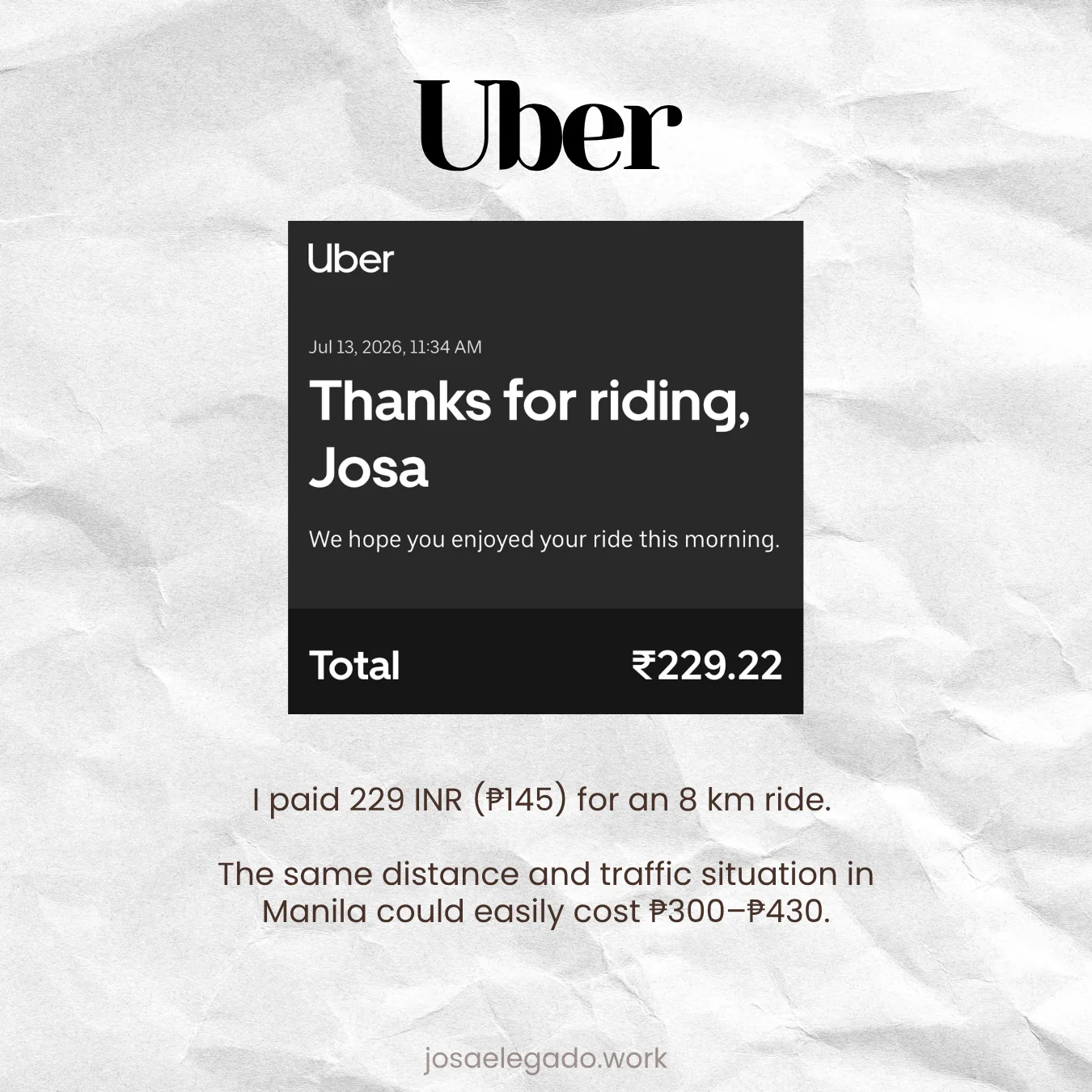
I stayed in Rajajinagar, and an air-conditioned Uber ride usually cost me around ₹230, or roughly ₱145. I think the most expensive ride I booked was only ₹335. For a similar distance in Metro Manila, I would’ve easily spent anywhere between ₱300 and ₱1,000, depending on traffic and surge pricing. Needless to say, I wasn’t expecting that.
Blinkit
The moment I arrived in India, my friends immediately told me to download Blinkit. I didn’t. On my last day in Bengaluru, I suddenly realized I hadn’t bought any pasalubong for my office mates. They specifically asked for Indian spices and chai, but I couldn’t find a nearby convenience store. (Sorry, I’m too used to having a 7-Eleven every few blocks in Manila.)
So my friend lent me his Blinkit account and told me to order whatever I wanted. At that point, my luggage was already so full that I was mentally preparing to sit on it just to zip it shut. Somehow, I still managed to order more.
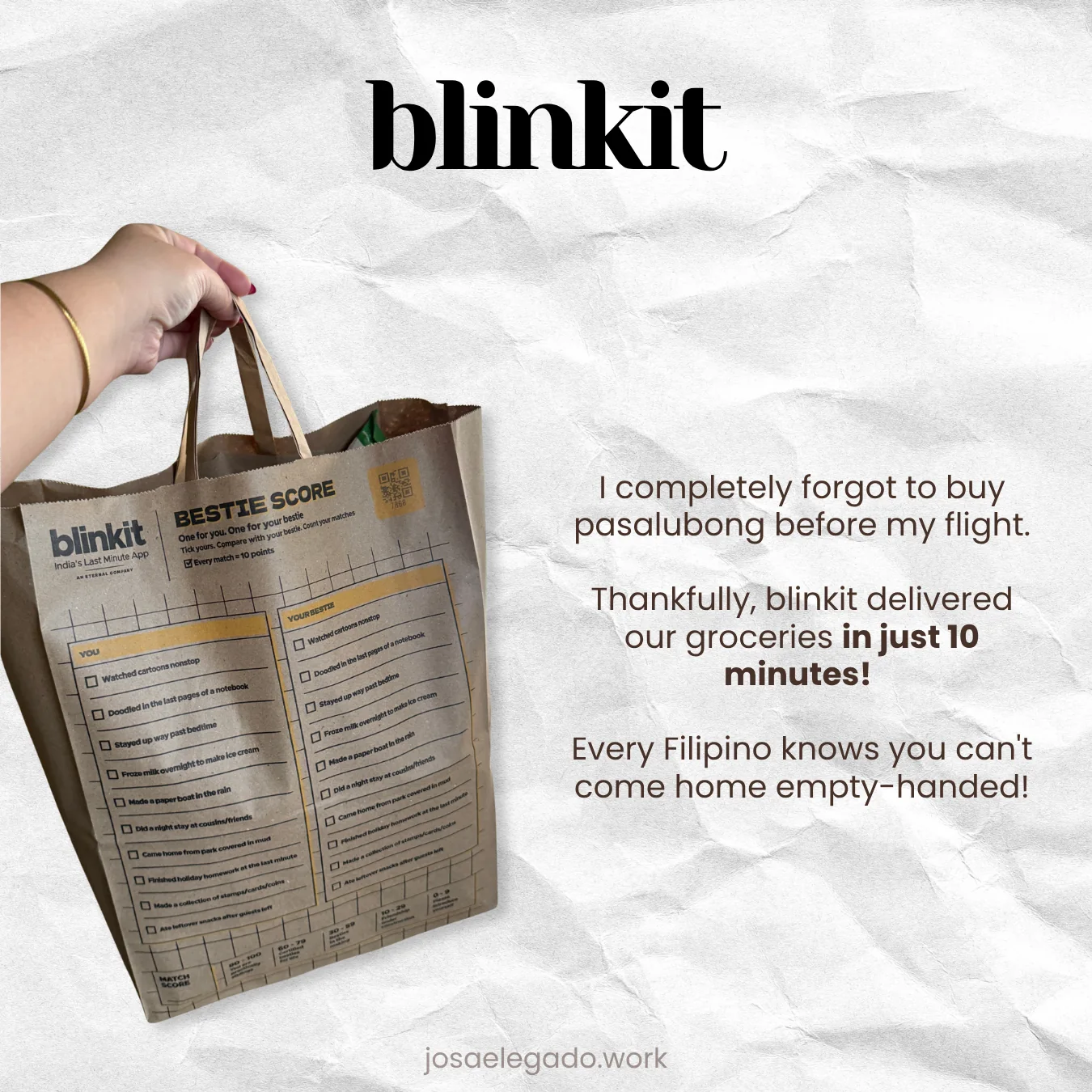
I expected the groceries to arrive in about an hour because my (low) expectations were based on GrabMart but to my surprise they arrived in ten minutes. Bro, Blinkit, please expand to the Philippines.
Food
Before leaving for India, I packed emergency food. Century tuna and Nissin cup noodles just in case my Filipino palate started looking for home. I never opened either of them.
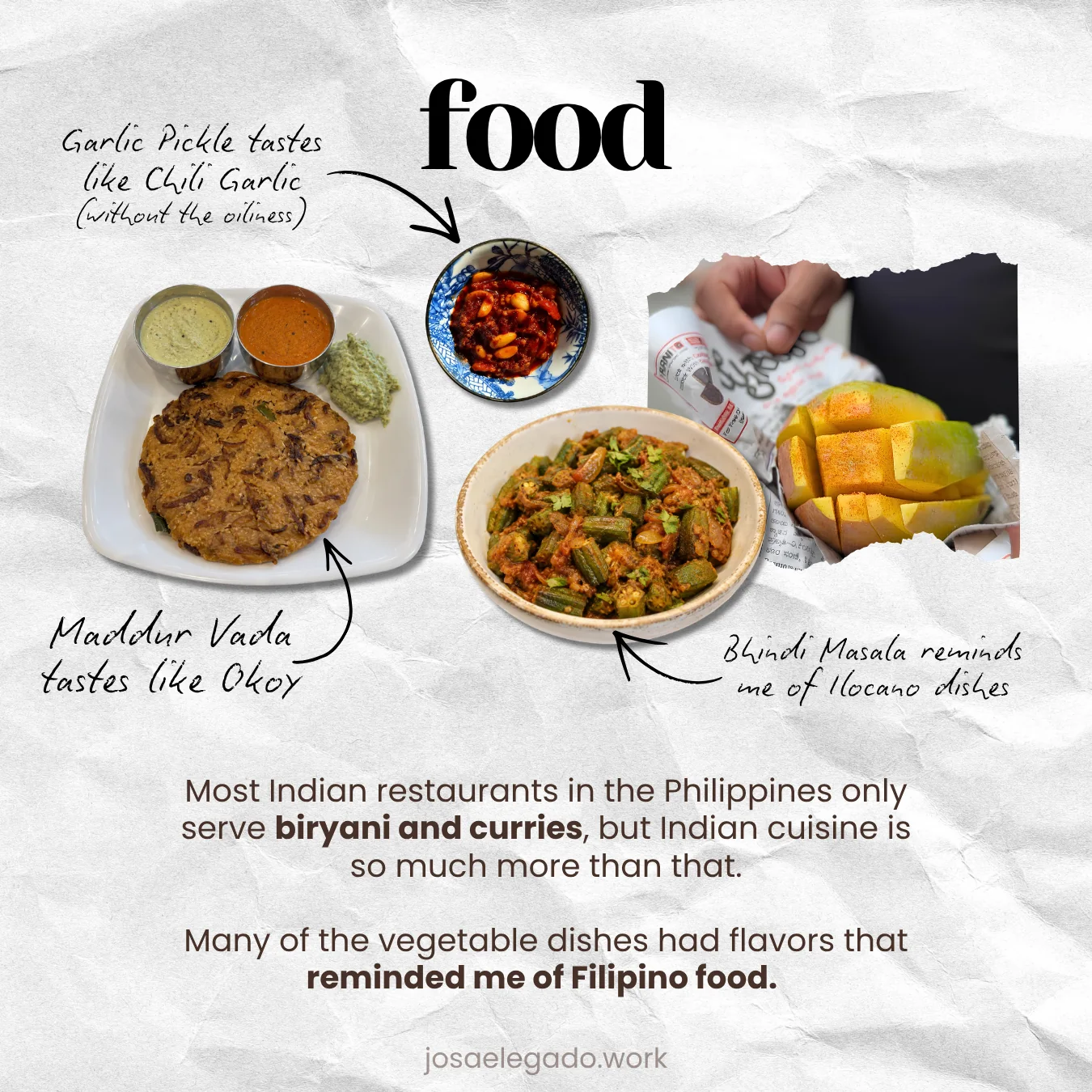
My Indian friends who lived in the Philippines had already “trained” me to appreciate Indian food, but eating it in India was a completely different experience. Yes, I ate curry and naan almost every day, but Indian cuisine is so much more than curries and biryani.
Maddur vada reminded me of okoy. Bhindi masala tasted surprisingly similar to some Ilocano vegetable dishes. Garlic pickle instantly became my favorite because it reminded me of chili garlic oil, except without the oil.
And don’t even get me started on desserts. Burfi, jalebi, and the mangoes. Please take me back.
UPI (Unified Payments Interface)
We spent an entire class in business school discussing India’s Unified Payments Interface (UPI) and how it transformed financial inclusion across the country. Reading about it in case studies is one thing. Seeing it in action is something else entirely.
At first, I thought, “So… it’s
basically GCash, right? bro, I was wrong”
Uber? Google Pay. Restaurants? Google Pay. Street vendors? Google Pay. Even tipping could be done through Google Pay.
One funny story. I couldn’t get my credit card to work in Uber, so I selected cash instead. When we arrived, I handed the driver a ₹500 bill. He smiled and simply showed me his Google Pay QR code because he didn’t have enough change. The problem? I hadn’t set up Google Pay. Thank God my friend was there to rescue me.
That was probably the first time I experienced the downside of a country becoming so digitally connected that cash actually becomes the inconvenient option.
SIM delivery
Getting a postpaid SIM card in the Philippines usually means preparing IDs, financial documents, proof of billing, and a bit of patience.
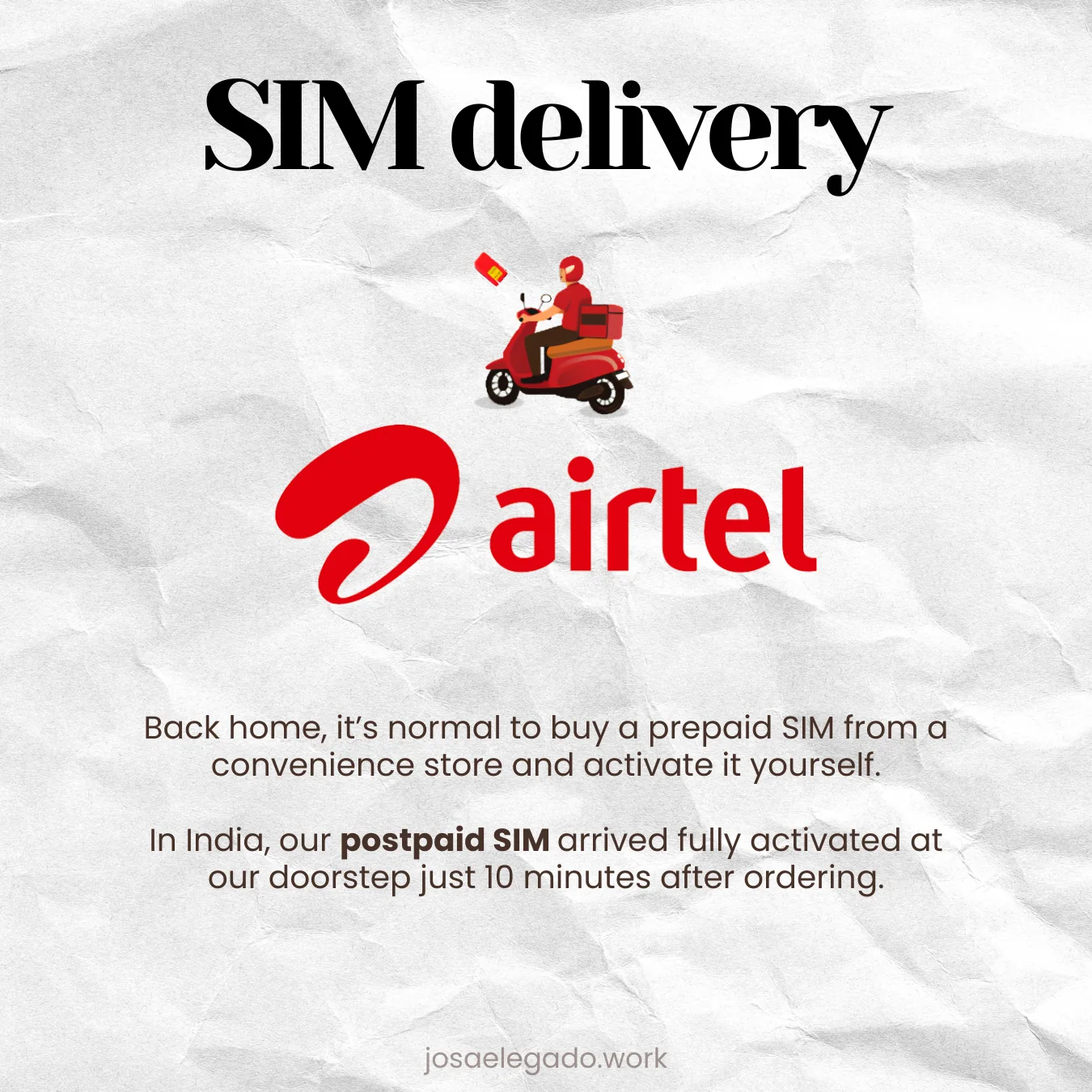
So when my friend ordered a postpaid SIM card for me and someone delivered it straight to the house a few minutes later, already activated and ready to use, I was honestly amazed. Door-to-door delivery and already activated. That’s it.
Shopping
We visited Mysuru on a Saturday, where I finally saw authentic Mysore silk sarees. Prices ranged from around ₹5,000 to ₹54,000, although I’ve heard some go for several lakh rupees.
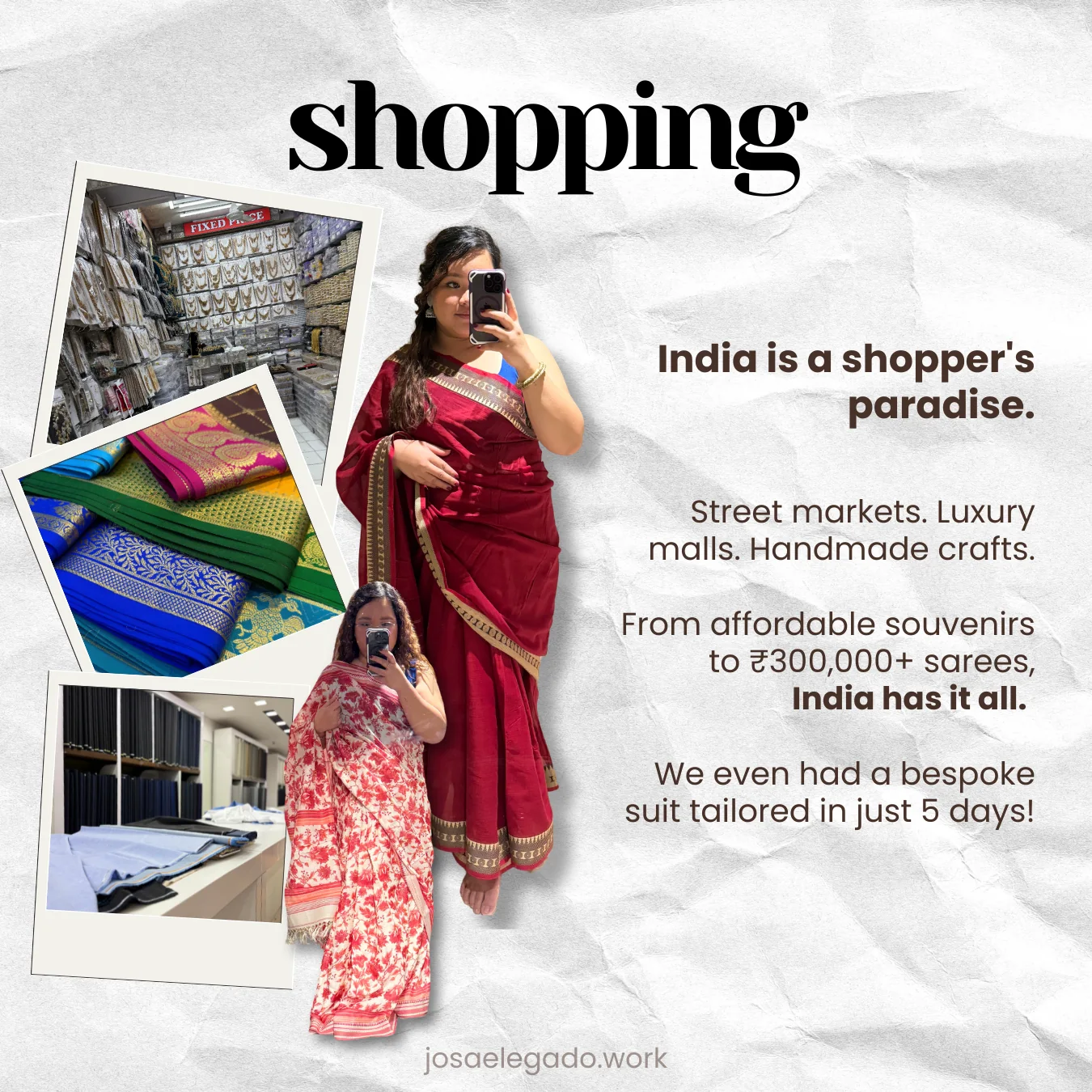
The following day, I went to Commercial Street with one of our interns, who patiently helped me choose a beautiful mul cotton saree. The fabric was unbelievably soft. I also bought bangles, jhumkas, kurtas for my office friends, and gifts for my sisters.
She told me I shopped a lot but she didn’t know I was actually trying to stop myself because I knew none of it would fit in my luggage.
I had originally planned to get a tailored suit in Vietnam later this
year, but my friend somehow convinced
forced me to get one in Bengaluru instead. Five days
later, I walked out of Reid & Taylor
with a custom-tailored linen suit. No regrets.
Chai and filter coffee
One afternoon, I asked a friend what I thought was a simple question. “Which do you prefer? Chai or filter coffee?” He couldn’t answer. Apparently, that’s one of the hardest questions you can ask a South Indian.

I’d tried instant chai before, and I’d always wanted to make it from scratch. Unfortunately, I couldn’t find most of the spices back home. As for coffee, the Philippines has amazing coffee from Batangas, Sultan Kudarat, and Benguet. But somehow, freshly brewed chai or filter coffee in India just felt different.
Imagine sitting in the living room on a rainy afternoon while everyone watches a cricket match. The smell of chai and filter coffee fills the house, conversations flow naturally, and no one seems to be in a hurry to be anywhere else.
It felt like a warm hug. I’d honestly pay just to relive that moment.
History
India’s history wasn’t something new to me. I’ve read about their heritage sites, old churches, museums, and palaces before.
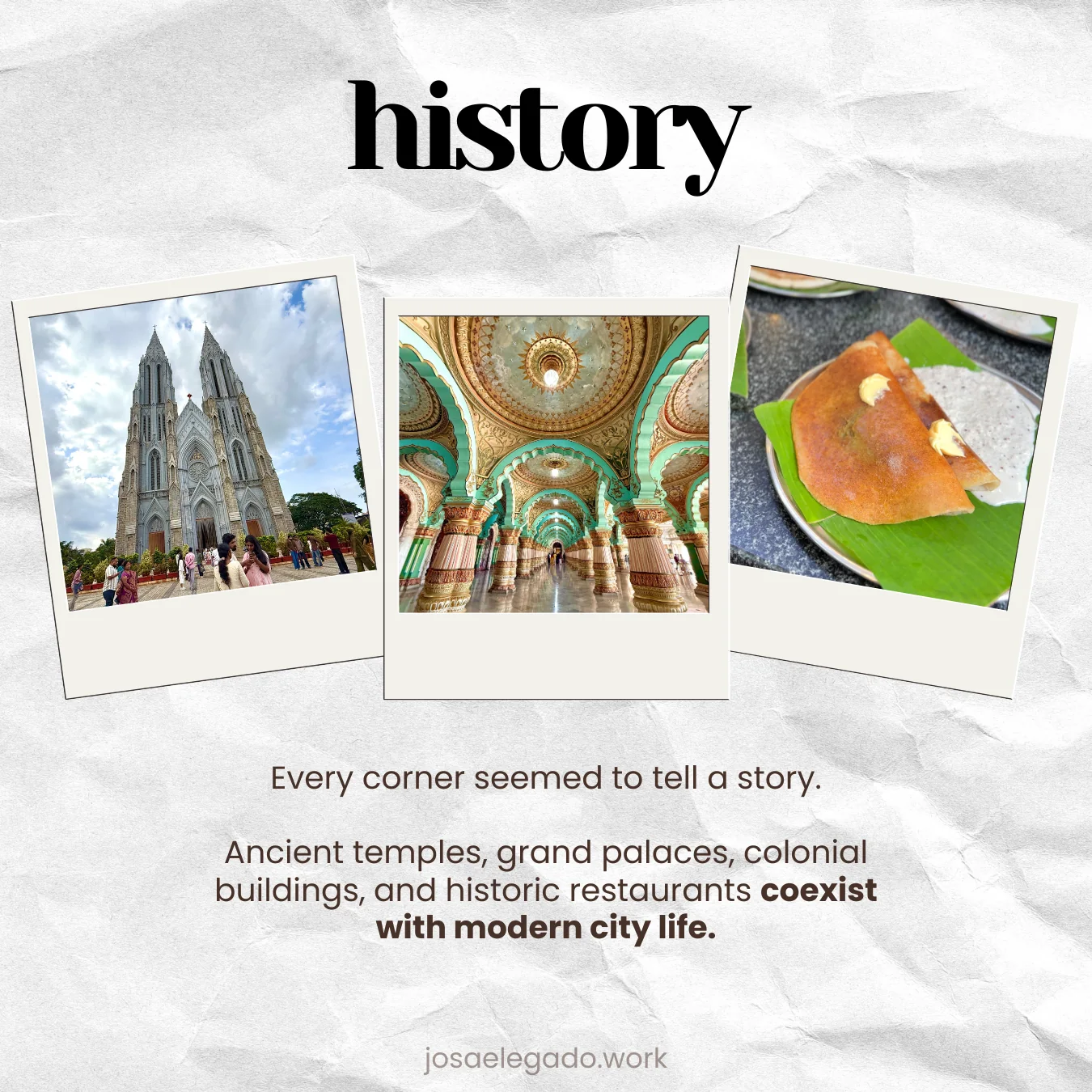
What fascinated me was seeing centuries-old buildings, restaurants, and traditions existing alongside one of the world’s fastest-growing technology hubs. It never felt like history was being preserved just for tourists. People were still living in it. That contrast was probably one of the things I appreciated the most.
Hospitality
My friend probably doesn’t know this, but one sentence he told me two months before my trip became one of the reasons I decided to push through despite everything that happened with the expo.
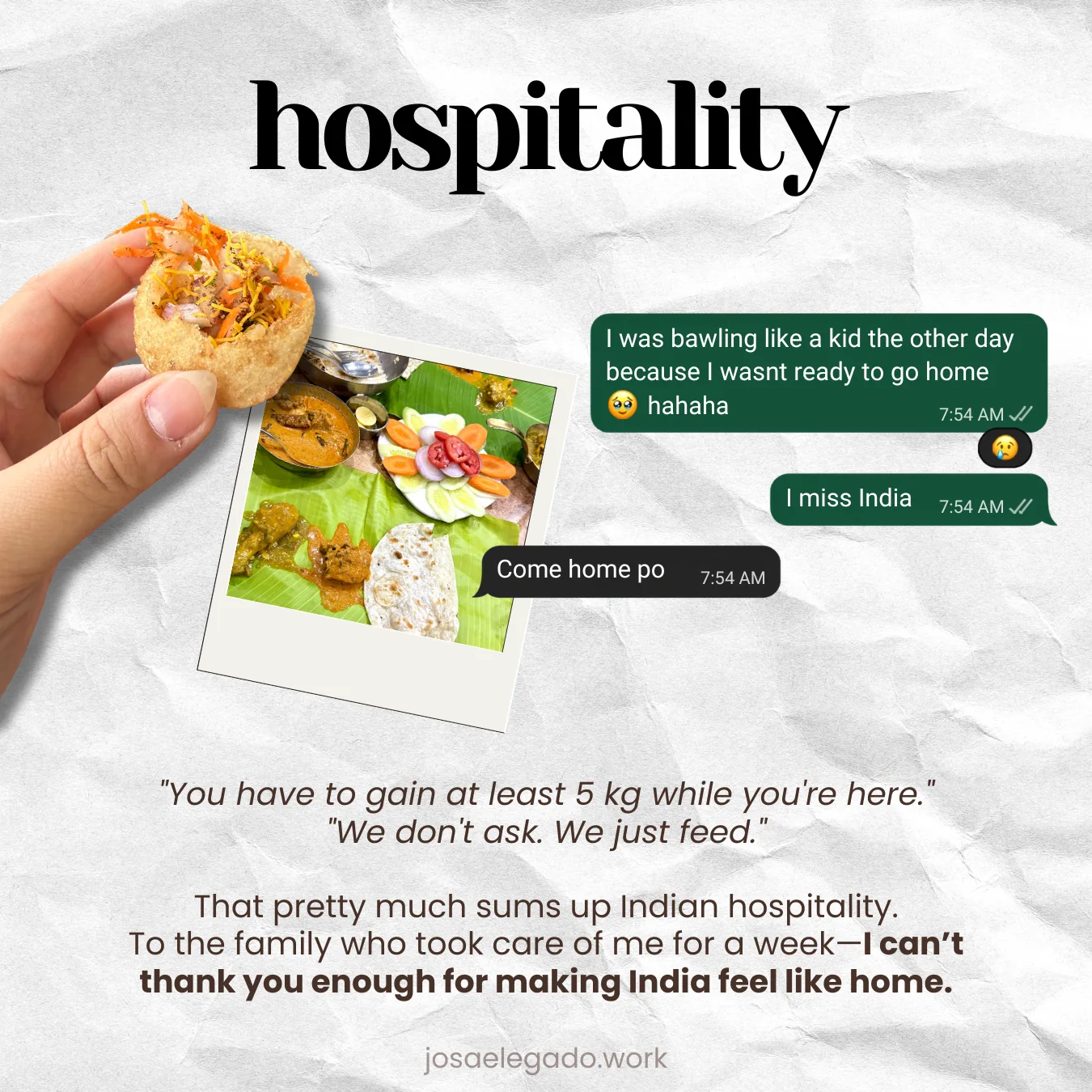
You have a home in Bangalore now, remember?
As someone who’s been living alone for years, that sentence meant more than he probably realized. After spending a week there, I finally understood what he meant.
I wasn’t just shown around the city. I was welcomed into a home. I was fed every day, driven around Bengaluru and nearby cities, introduced to friends and family, and treated like I wasn’t just visiting.
To the Sadhu Prabhakara family, thank you. Thank you for welcoming me into your home, making sure I was never hungry, introducing me to your culture, and making India feel less like a foreign country and more like home. I’ll always be grateful that our paths crossed.
Why I’d love to go back
I visited a lot of places in just one week, but I know India has so much more to offer. I still want to see the Taj Mahal, Agra, Mumbai, St. Thomas Cathedral in Tamil Nadu, and many more places I’ve only read about.
Looking back, missing the solar expo turned out to be a blessing in disguise. Had everything gone according to plan, I probably would’ve spent most of my time inside a convention center. Instead, I experienced everyday life. I learned about India not from presentations or keynote speakers, but from authentic Indian food, cups of chai, family dinners, conversations in living rooms, and people who welcomed a stranger as if she’d always belonged there.
That’s the India I’ll remember. And that’s the India I’ll keep coming back to.
- Filed
- August 2026
- Fieldwork
- July 2026
- Related
- All field notes
- Status
- Complete — first entry in the journal